
I'm writing this on the flight home to Perth from AISA CyberCon 2026 in Melbourne. It has been a smooth one, which after three days of being told the sky is about to fall in feels almost suspicious. The only drama on board was the man behind me, who had half the cabin and two flight attendants on a search for a missing AirPod. Floor, aisle, under the seats, the overhead locker. It was in his seat pocket the whole time.
This was my fifth CyberCon. I try to go every second year, so my last was 2024. Every previous time I have walked out of the convention centre in one of two states: fired up and desperate to get back to work, or completely overwhelmed, with a notebook full of threats and no idea which one to tackle first. Both feel productive at the time. Neither really is.
This year was different, and it took me until somewhere over the Nullarbor to work out why.
Every year I arrive at CyberCon with the same question: what's next? And every year the industry gives me the same answers it gave me last time, with new acronyms. Email security. MDR, then XDR. GRC. And bloody AI, which we have been talking about at every CyberCon I can remember, long before ChatGPT, back when the future was Siri, Alexa, Google Assistant and Cortana (who remembers that wild ride?). If this year's programme is any guide, the next answer is quantum, and in five years we'll be sitting in the same rooms being told the sky is falling for a new reason.
So this year I searched properly. Every session, every vendor pitch, every hallway conversation. The next thing was never on the floor of the convention centre. It was in my pocket the whole time, in the way we already work.
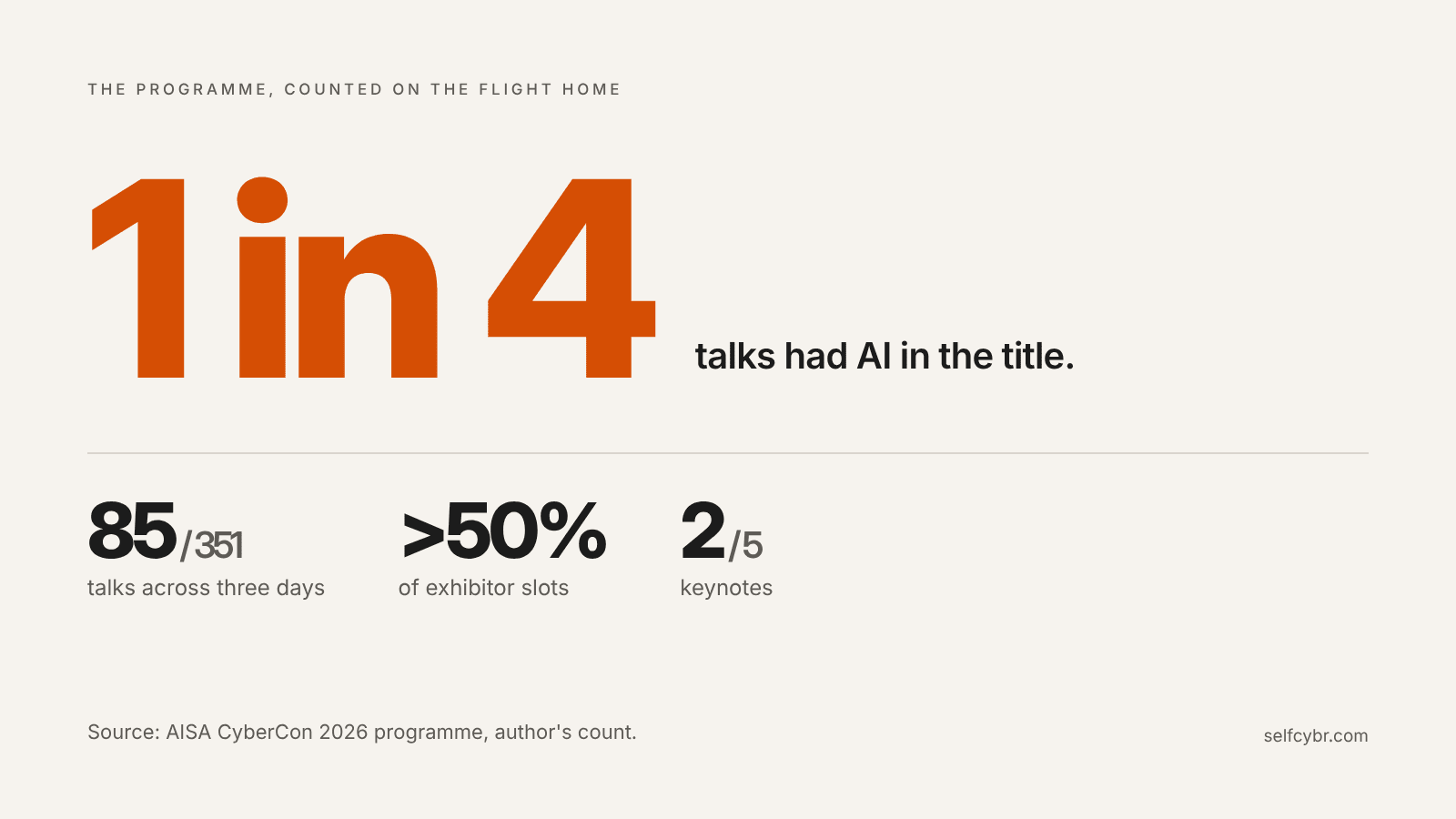
One number sums up the week. I went through the programme on the plane and counted: of the 351 talks across the three days, 85 had AI in the title, almost exactly one in four. In the exhibitor slots it was more than half. Two of the five keynotes carried it too.
Two ideas followed me onto the plane, and a few others are worth passing on. This isn't a session-by-session recap; AISA will publish the recordings. And it isn't the business post; that one is coming separately and covers why I think vulnerability management as we know it has about 18 months left. This one is about how we decide things, and why nobody on the main stage could agree about AI.
1. The cost of the status quo, and the bias brain that hides it
Tané Hunter's featured talk was billed as a session on adaptability. The part that stuck was about how badly our brains price the option of doing nothing.
Every decision gets weighed against the risk of changing. Almost none get weighed against the cost of staying the same. The status quo feels free because its costs arrive slowly, spread across months, and nobody is ever blamed for them. Changing course has a visible owner and a visible failure mode. So the bias brain, left alone, will choose inertia every time and call it prudence.
Hunter's argument is that you can't train this out of people. Confirmation bias, sunk cost, overconfidence, deference to the most senior voice in the room: none of it goes away. So stop trying to fix the brain and fix the output instead.
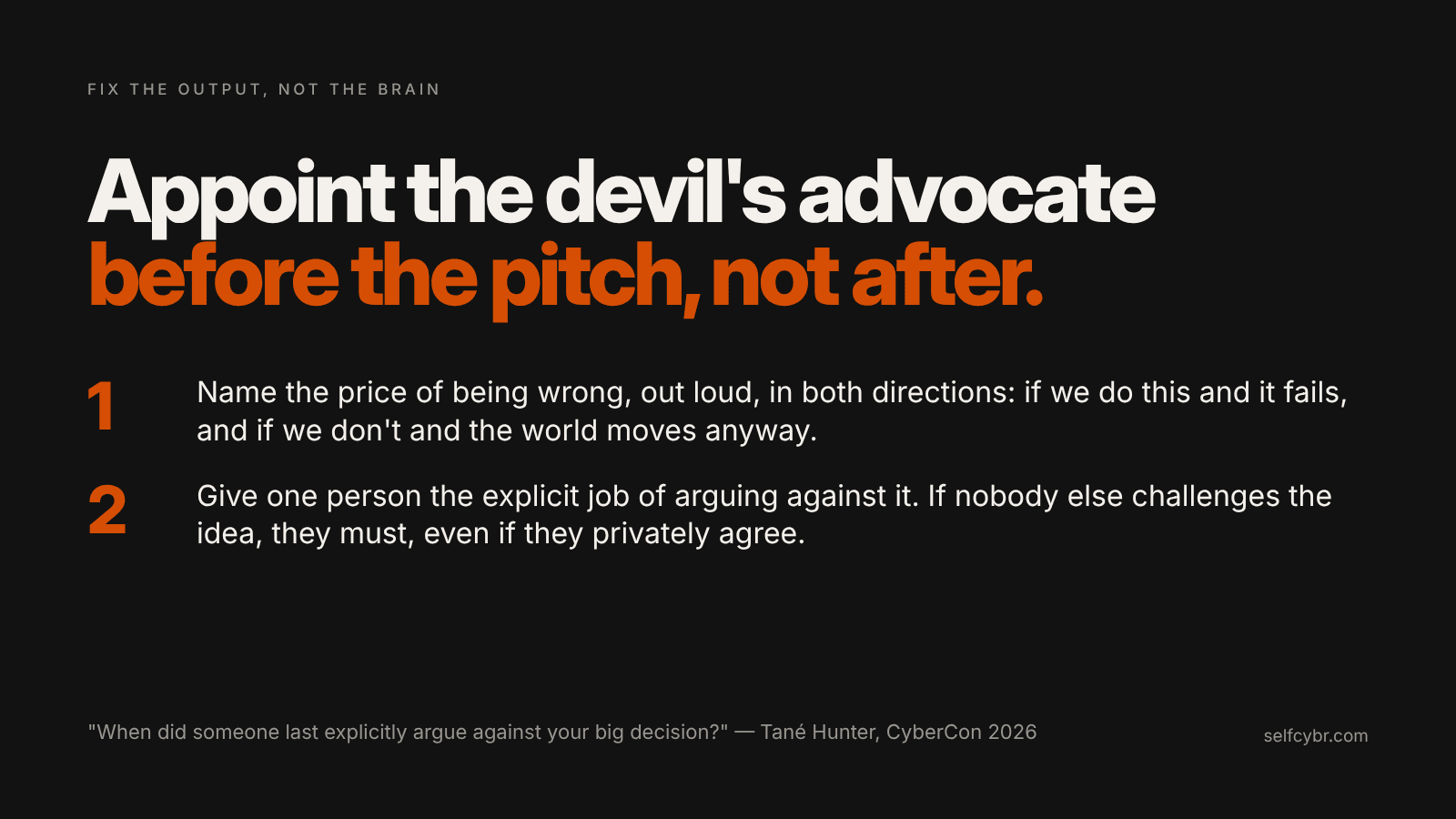
Two mechanisms. First, before you commit, name the price of being wrong out loud, and name it in both directions: what it costs if we do this and it fails, and what it costs if we don't and the world moves anyway. Second, give one person in the room the explicit job of arguing against the decision. Not "does anyone have concerns?" That question almost never produces a challenge, because speaking up costs reputation and relationships, and most people have done the maths. The devil's advocate is appointed, and appointed before the pitch is made, not after the room has already warmed to it. If nobody else challenges the idea, they must, even if they privately agree with it.
He put a question to the room that I'm still sitting with: when did someone last explicitly argue against your big decision? If the answer is never, your biases are making your decisions for you.
This lands squarely on how I try to lead. I talk about explicit leadership, which means the expectations, the decision and the reasoning are said out loud rather than left for people to infer, and curiosity leadership, which means the leader's first job is to ask one more question than they need before deciding. Hunter put the second one better than I ever have: collect more dots before you connect them. The moment you rush to connect, curiosity collapses into assumption. An appointed devil's advocate is simply those two values turned into a rule, because a challenge that has been asked for costs the challenger nothing.
His cautionary tale was Klarna. As he told it, they announced an AI assistant doing the work of 700 staff, 2.3 million conversations handled, resolution times down from 11 minutes to 2. Eighteen months later, satisfaction was down, complaints were up, and the CEO admitted they had over-indexed on cost. They are now rehiring humans into a hybrid model. Hunter's read was that the mistake wasn't the AI. It was removing the people before anyone understood what they held, which was context.
A personal note on that. I admire that the CEO called the mistake publicly and changed course; most don't, and the ones who do tend to be the ones worth working for. I'd add one caution, though. Everything we learn about the inner workings and culture of a company through social media and press is seen through rose-coloured glasses, the recovery story included. The public version of a culture is a marketing artefact. The real test of whether Klarna now has a devil's advocate in the room is a decision we will never see.
From this week, every decision at SelfCybr that would cost us more than a month to unwind gets a named devil's advocate, and the cost of not deciding gets written down next to the cost of deciding. I'd suggest the same for any board, any leadership team, and frankly any household making a big call about money.
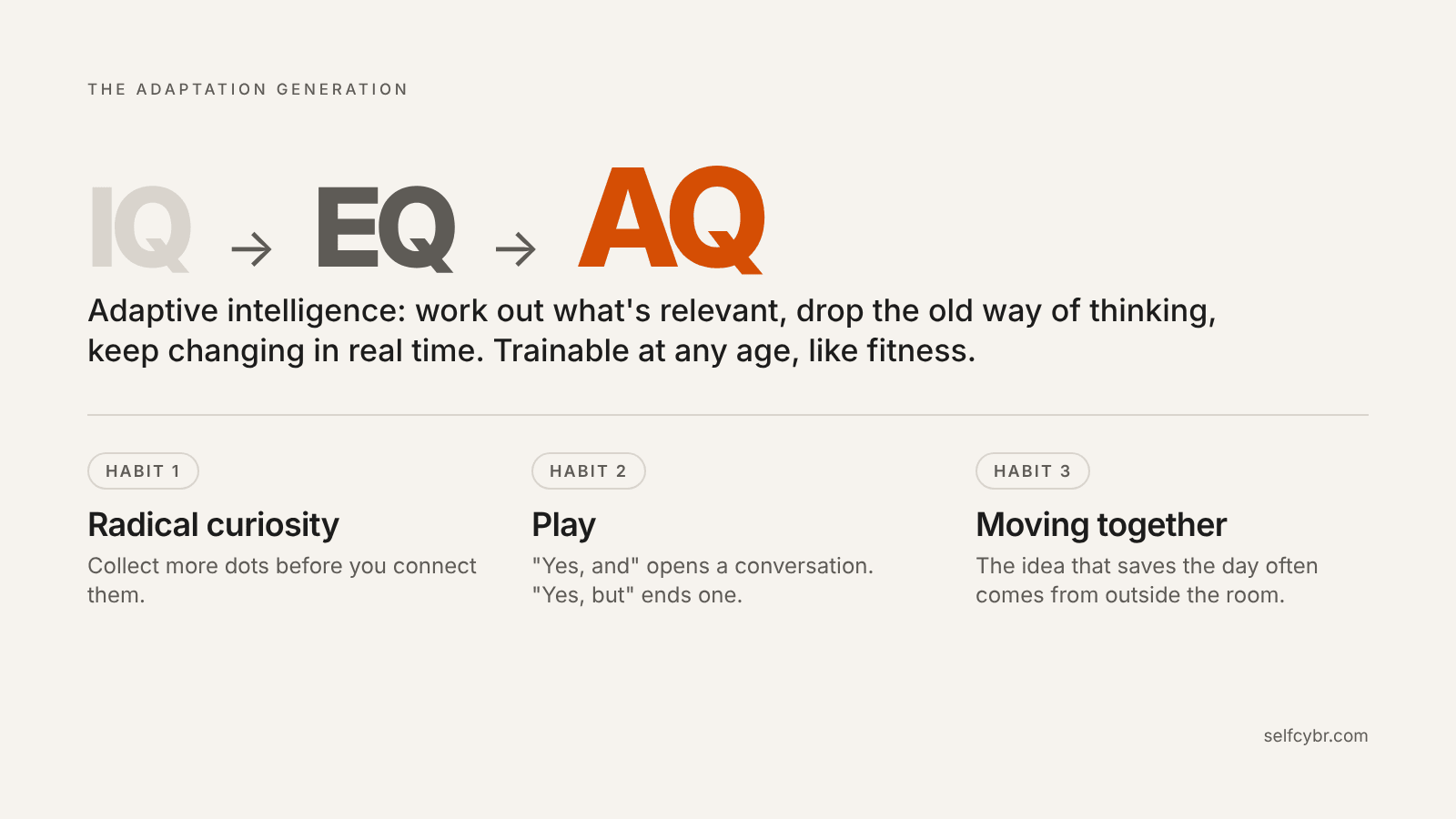
The other half of Hunter's talk gave the bias work somewhere to go. His argument was that we have lived through three once-in-a-generation disruptions in five years: COVID, AI and climate. He calls us the adaptation generation. For a century the measure of a person was IQ. Then it was EQ. He thinks the one that matters now is AQ, adaptive intelligence: the ability to work out what is relevant, drop the old way of thinking, and keep changing in real time. Bending without breaking. IQ and EQ get you in the door; AQ is what keeps you there. And his claim, which I found reassuring, is that it is trainable at any age, like fitness.
He gave three habits to train it. Radical curiosity: collect more dots before you connect them, and ask one more question than you need. Play: the improv rule of "yes, and," where "yes" accepts the situation as it is and "and" is where your agency comes in. "Yes, but we tried that" ends a conversation; "yes, and here's how it could work this time" opens one. And moving together: his example was the Thai cave rescue, ten thousand people from more than twenty countries, where the idea that saved thirteen lives came from a retired firefighter, not a doctor, and the government's job was to absorb the legal risk so the people doing the work had room to do it.
I wrote his three habits down on the plane and then noticed I already carried a version of that list. More on that at the end.
2. Nobody actually knows what is happening with AI
A confession first, in the spirit of the section above. My own bias going in was to avoid the AI talks. Every second article, video and seminar in this industry is about AI, and I think I speak for a lot of us when I say that nobody has yet asked the presenter whether there's anything else they can tell us about, but we are all sitting there thinking it. It's the person at the family gathering who won't talk about anything but themselves. So I skipped a few of the AI-titled sessions on purpose. It made no difference. The ones without AI in the title or abstract still spent a chunk of their time on how they were using it, in some shape or form. There was no avoiding it, so I stopped trying.
What got me out of that sulk was a conversation with a student at the Pride in Security meetup on Thursday night, which is a thing CyberCon does now and worth celebrating in itself. Comparing notes on the week, it clicked that the problem was never the topic. It was context. A keynote gives me a frame for the whole industry, the networking gives me someone's actual problem, and the exhibition hall shows me what the market thinks is worth money. Surprise, surprise, given that half the AI talks were about exactly that.
And for all that AI on the programme, the most honest thing I heard all week was the disagreement between the keynotes.
In one corner, the optimists. Jason Clinton, Anthropic's CISO, laid out the compute curve (training compute up roughly 4x a year since the first perceptron in 1957) and the attack picture it produces: round-the-clock, wave-based, AI-driven intrusions where you often can't tell which model is behind them. His prediction is that the next 18 months will be the roughest of our careers, with a Log4j-scale incident roughly every month. And then he said the thing nobody expected: there is a rainbow at the end. Vulnerabilities effectively eliminated, software nearly free to build, and a permanent advantage to defenders. His message to a critical infrastructure forum that "felt like a funeral" was to reject helplessness. One could argue, of course, that the CISO of an AI company has his own bias towards AI's success. He'd probably agree.
In the other corner, the people who think we are standing at a fork. Jen Easterly, now CEO of RSAC, opened with 9/11 and the phrase "failure of imagination." Her framing was that when you invent the ship you invent the shipwreck, and her worry is that we are shipping AI faster than we are imagining the wreck. Sir Tim Berners-Lee compared AI to nuclear technology: companies have to test continuously, governments have to regulate, and the people building the most powerful systems need to be in the same room. He argued for a CERN-for-AI. The thread running through that camp was that AI itself isn't the problem. The problem is three sets of decisions: the ones being made by the teams building the models, the ones not being made by the governments that should be regulating them, and the ones made every day by the people using the products. Put that way, we're at a crossroads, and what gets decided in the next six months or so decides which way we go.
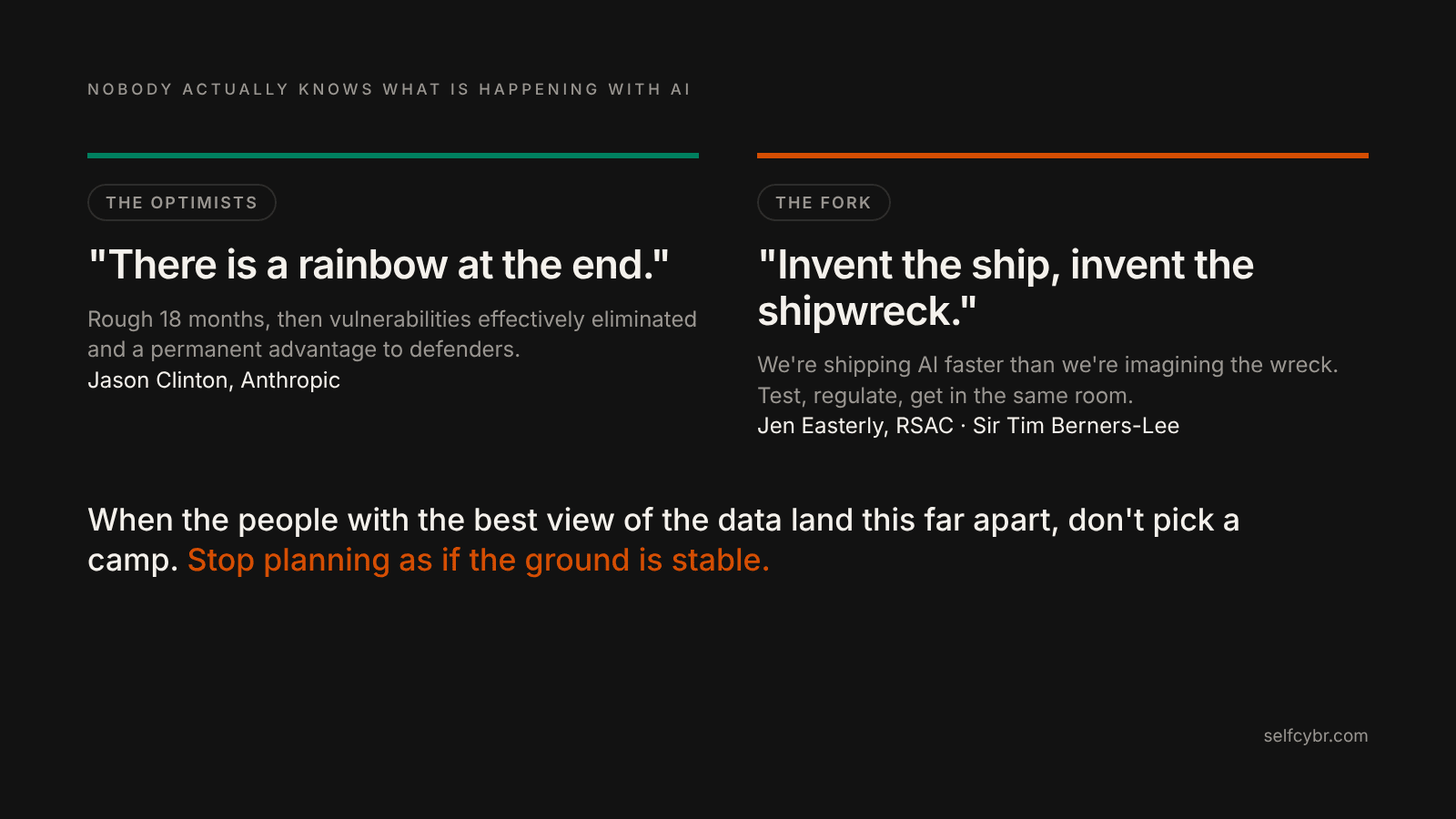
So who do you trust? The insider at an AI superpower, who sees the capability curve every day and has every reason to believe in it? Or the outsider, who sees the wreckage and has every reason to be a critic? I don't think either camp is better than the other, and I think that is the point. We all want to believe we will be better off with AI, and to this day we are. What keeps the fear barrier up for a lot of people isn't the evidence. It's uncertainty, and the bias brain's preference for the known over the unknown, which is the same bias that priced the status quo at zero in the section above.
It helps me to ask whether this is new. When the calculator arrived, did we say kids would never learn maths again? Some of us did. Is generative AI just the calculator of the language world? I keep coming back to the scene in Hidden Figures where the IBM mainframe is wheeled into NASA and the human computers, the women whose job title was literally "computer," realise that a core skill is about to be done by a machine. They don't picket it. They learn to program it, and they walk into the new room as the people who already understand the work. That is the adaptation Hunter was describing, more than sixty years before anyone put AQ on a slide.
My read: when the people with the best view of the data land this far apart, the honest position for the rest of us is not to pick a camp. It is to stop planning as if the ground is stable. The people who do best in the next two years will be the ones who can change their minds fastest, which is exactly why the appointed devil's advocate above matters. The cost of standing still is the one nobody in the room is pricing.
Three more worth your time
Criminals target vulnerable moments, not vulnerable people. Tracy Hall's keynote on unhackable humans was the most personal session of the week. She lost $317,000 to a man she knew as "Max" over 18 months; he turned out to be Hamish McLaren, with 15 Australian victims and an estimated $80 to 100 million globally. Her point was that the psychology is the attack: emotional hijacking, urgency, deference to authority, and shame as the thing that keeps people from reporting. Her practical advice was small and good. Agree a family password. Switch your voicemail to the default system greeting so your voice can't be cloned from it. And change how we write about scams: headline the criminal, not the victim.
Tech abuse is a behaviour problem, not a technology problem. Emerald Sage from The Digital Resilience Project described how domestic abuse goes digital: a grooming phase ("if we love each other we don't have secrets"), an access phase ("just share your passwords"), and escalation at the exact moment someone seeks help. Her examples were the smart fridge and the pet feeder, and they made a room full of security people realise they had been looking at the wrong threat model. The caseworker, not the technician, has to sit at the centre of any response.
The incident hotline is the product. The cyber insurance workshop for SMEs had one message both underwriters agreed on: the first-party crisis cover, the number you call when you suspect a breach, is where small businesses get the most value. The market is soft now and expected to harden within 18 months. Social engineering cover is already declined outright if you don't verify bank detail changes by call-back. If you run a small business, check that clause before you need it.
What this means if you're not a CISO
Most of CyberCon is pitched at people who run security for large organisations. Strip that away and the week's lessons translate cleanly to a household or a ten-person business.
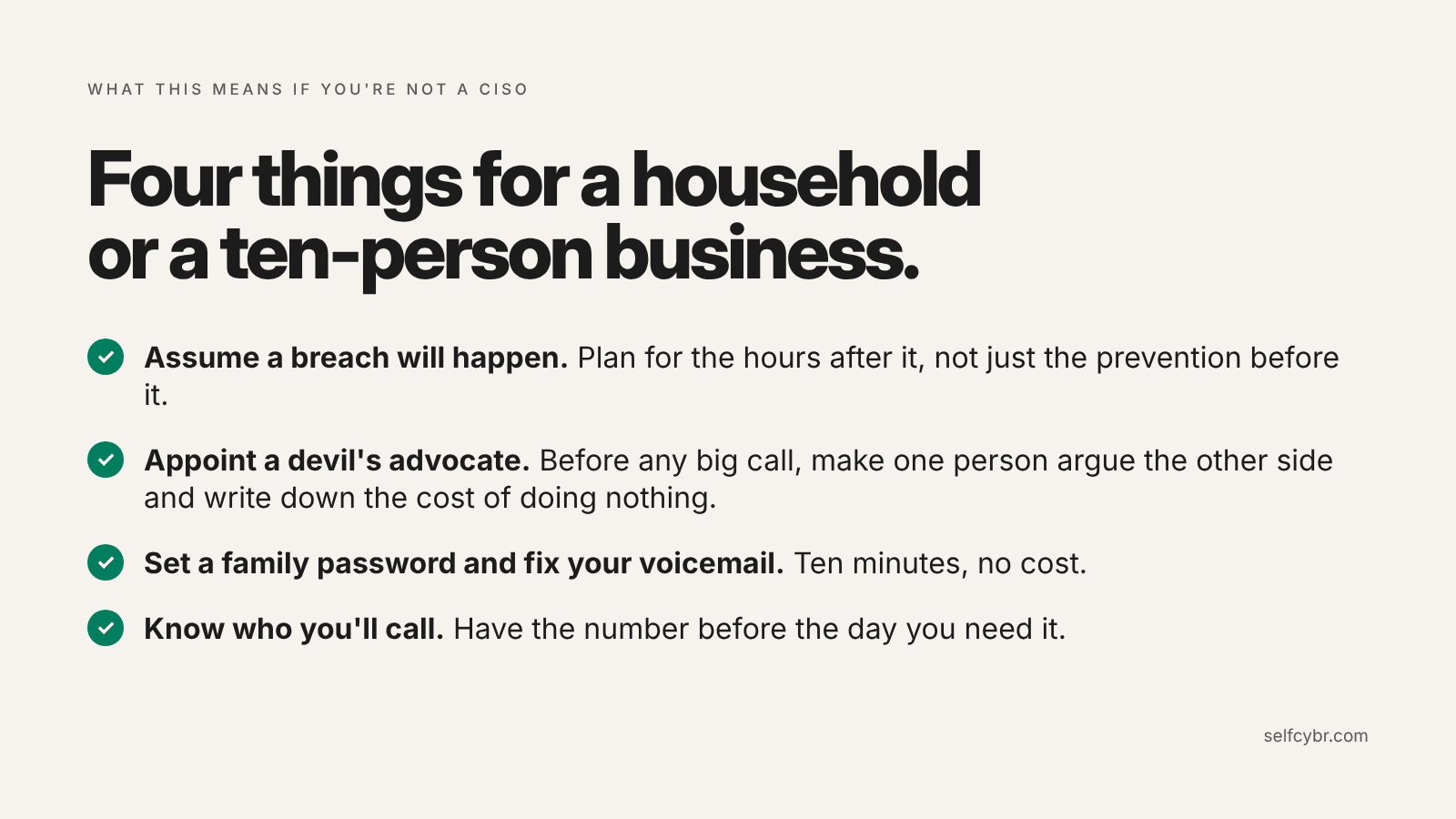
- The attackers are automating. Assume a breach will happen and plan for the hours after it, not just the prevention before it.
- Appoint a devil's advocate. Before any big decision about money, a new provider, or a message that feels urgent, make one person argue the other side, and write down what it costs to do nothing.
- Set a family password and fix your voicemail. Ten minutes, no cost.
- Know who you'll call. Whether it's your insurer's hotline, your IT provider, or us, have the number before the day you need it.
The experts don't agree on where AI takes us. They do agree on this: the people who will be fine are the ones who already know what they'll do when something goes wrong.
We're starting our descent into Perth and the flight has stayed smooth the whole way. I don't expect the next 18 months to be like that, and neither did anyone on the main stage. But I'm not landing with a list of things to fix this time. I'm landing with a way of working that I already had and now trust more: listen before we act, collaborate rather than compete, say plainly what we know and don't know, and adapt when the evidence changes. With integrity, and with curiosity. That is the whole plan. I didn't find it in Melbourne. I brought it with me, and spent three days looking for it anyway.
Related reading