
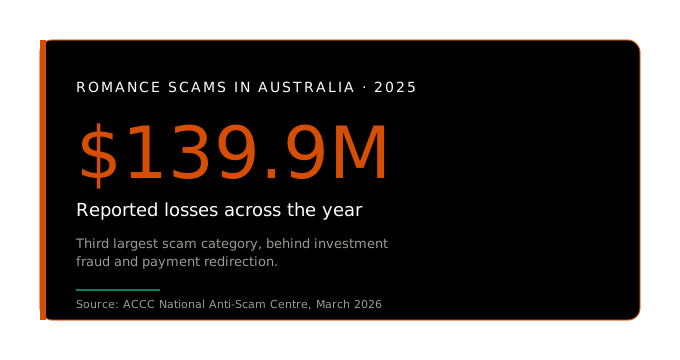
Australians lost $139.9 million to romance scams in 2025. That's the figure the ACCC's National Anti-Scam Centre published in its March 2026 Targeting Scams Report, drawing on combined data from Scamwatch, ReportCyber, IDCARE, the AFCX and ASIC. It was the third-largest scam loss category in the country, behind only investment fraud and payment redirection.
The real number is higher. Most romance scam victims never report. Shame keeps them quiet. So does the belief — often correct — that the money is gone and no one is coming to get it back.
At SelfCybr, we hear from families almost every week who are watching this happen to someone they love and don't know what to do. The pattern is almost always the same. Someone vulnerable — often older, often isolated, often dealing with grief or illness — has met someone online who is "different from everyone else." A celebrity. A surgeon working in Yemen. A widowed engineer on an oil rig. Someone who understands them. Someone who finally sees them.
And the person who loves them is sitting on the other side of the kitchen table, watching the savings drain, and being told they're the one who doesn't understand.
This article is about how those scams work, the tactics that make them so effective, and what to do if it's happening in your family.
How a romance scam actually works
Most people picture a romance scam starting on a dating app. The more accurate picture, according to ACCC data, is that over 80% of romance scam losses in 2025 came from online contact — and social media accounts for more initial contact than dating apps do. Facebook, Instagram, comment sections under celebrity posts, fan groups, mobile games like Words With Friends. These are the entry points. People lower their guard on platforms they use daily for genuine social connection.
The mechanics are predictable once you know them.
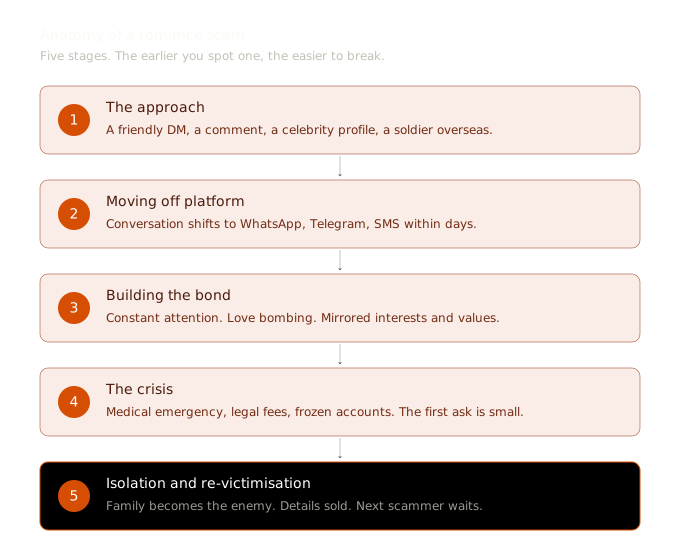
Stage one — the approach. A friendly DM. A comment that feels personal. A "hello" from someone whose profile looks just real enough. Sometimes the scammer pretends to be a celebrity. Sometimes a doctor, a soldier, an oil rig worker, a widower. Frequently they claim to be from somewhere far away — which conveniently explains why they can never meet in person and why phone calls and video are difficult.
Stage two — moving off-platform. Within days, sometimes hours, the scammer wants to move the conversation to WhatsApp, Telegram, Signal, or SMS. This is one of the most reliable red flags. It happens because dating apps and social platforms are increasingly good at flagging scam accounts, and scammers want the conversation somewhere they won't be detected and won't lose access if the original profile is taken down.
Stage three — building the bond. Long messages. Constant attention. Good morning, good night, all day every day. They mirror your interests, your values, your hopes. They tell you you're the most important person in their life. This is sometimes called "love bombing," and it's deliberate. The ACCC's Romance Scam Fusion Cell, which ran through the second half of 2025, identified this as the pivotal mechanism: an emotional bond strong enough that, by the time a request for money comes, the victim isn't evaluating it the way they would evaluate a request from a stranger. Because they don't believe it is a stranger.
Stage four — the crisis. Something happens. A medical emergency. Legal fees. Frozen bank accounts. Customs holding a package. A business deal that needs a small bridge loan. The first ask is almost never enormous. It's often framed as a loan, as something they'll pay back as soon as the crisis resolves. The amounts escalate. The crises multiply.
Stage five — isolation and re-victimisation. Friends and family who raise concerns are framed as jealous, controlling, or not understanding the relationship. The victim withdraws from people who might pull them out. And once a person has been scammed once, their details are sold and shared across scam networks. They become a repeat target. New scammers, new personas, same playbook.
The new layer: AI, deepfakes, and celebrity impersonation
The classic romance scam has been around for decades. What's changed in the last two years is the tooling.
Generative AI has removed the two biggest tells that used to give scammers away: bad English and grainy photos. Scam messages today are grammatically fluent, emotionally articulate, and culturally calibrated. The FBI has noted that AI has stripped out the spelling errors and unnatural phrasing that once served as scam indicators. What used to read as "obvious fake" now reads as "thoughtful and articulate."
The image side has changed even faster. Scammers now use what some have called "Persona Kits" — packages of AI-generated photos, voice samples, and even short video clips of a fabricated person. For celebrity impersonation scams, deepfake technology can produce a short, low-resolution video call where the celebrity appears to wave hello. Reports from the BBC, Crime Stoppers Victoria, and refund advocacy services have documented exactly this: victims who asked for video calls, got them, and saw what looked enough like the person to silence their doubts.
Celebrity impersonation deserves a particular mention because it's been growing fast and it's the variant most likely to seem absurd from the outside. People say, "Surely no one believes a Hollywood actor is messaging them." Plenty of people do — and the demographics of who falls for it are not what most assume.
Documented cases from the last two years include:
- A French woman who sent approximately €830,000 to scammers impersonating Brad Pitt, complete with fake press articles and AI-generated images explaining why his accounts were "frozen due to divorce proceedings."
- A 67-year-old widow in San Diego who sent more than US$60,000 to a fake Keanu Reeves over two years.
- A US woman who sent over US$375,000 to someone pretending to be actor Martin Henderson.
- A 73-year-old retired office manager whose case was detailed in The Hollywood Reporter, scammed by a fake Kevin Costner, who — after that scam collapsed — moved on to believing she was dating Jonathan Roumie, the actor who plays Jesus in The Chosen.
- An Australian who lost approximately A$80,000 to a deepfake Elon Musk investment scam.
The list of impersonated celebrities is long and predictable: Keanu Reeves, Kevin Costner, Brad Pitt, Tom Hanks, Jason Statham, Helen Mirren, Kelly Slater, Mariah Carey, Elon Musk. The pattern across all of them is that they're public figures with large, emotionally invested followings — people who already feel a connection to them through years of films, posts, or interviews. Scammers don't have to build affection from scratch. The parasocial bond is already there. They just have to redirect it.
Keanu Reeves, by way of one telling data point, pays a company called Loti to track down online impersonators. Loti has issued nearly 40,000 takedown orders for Reeves impersonators in a single year. It still isn't enough.
Why family members rarely break through
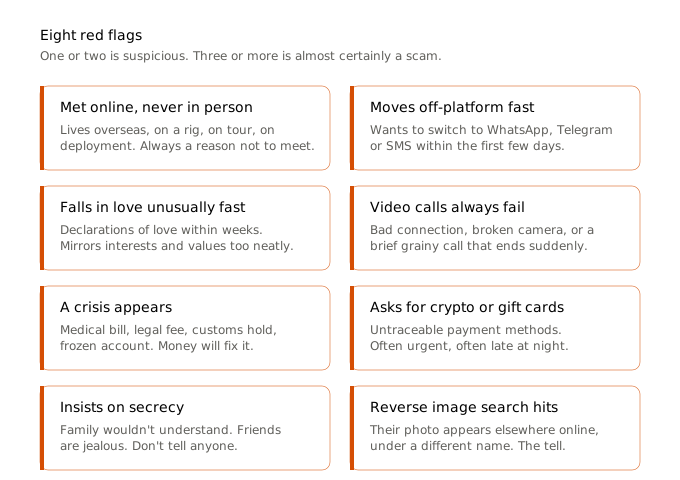
If you've ever tried to convince someone you love that the person they're talking to online isn't real, you already know the strange shape of this problem. The more obvious it looks from outside, the more entrenched the position from inside.
Three things explain most of it.
The emotional sunk cost. Months or years of intimacy, hope, plans, secrets shared. To accept the scam is to accept that none of it was real. That's not a piece of information someone updates on; it's an identity loss. The brain protects against it, sometimes ferociously.
Active isolation by the scammer. Sophisticated scammers anticipate that family will object. They pre-empt it. "Your daughter doesn't want you to be happy." "Your son is after your money." "They've never understood you the way I do." By the time the family raises concerns, the victim has often been primed to expect exactly this and to interpret it as proof of love rather than concern.
Cognitive and emotional vulnerability. This is the part that doesn't get talked about enough. Romance scams are not evenly distributed across the population. Older Australians bear a disproportionate share of losses — people aged 65 and over represent about 17% of the population but account for 26.5% of total scam losses reported to Scamwatch. The ACCC's 2025 data showed a 93.5% increase in scam reports from people with disability. Neurodegenerative conditions, brain injury, mental illness, grief, and social isolation are all amplifiers. Conditions that affect executive function, impulse control, or emotional regulation — Huntington's disease, early-stage dementia, Parkinson's disease — can make it dramatically harder for someone to step back from an emotional bond and assess it rationally, even when part of them suspects something is wrong.
This is a critical and often misunderstood point. The victim is not "stupid." They are not "weak." In many cases they are someone whose brain is processing the relationship in a way that doesn't allow the normal skepticism circuits to fire. Treating them as if they should "just snap out of it" is one of the most reliable ways to entrench the scam further.
What to do if you suspect someone you love is being scammed
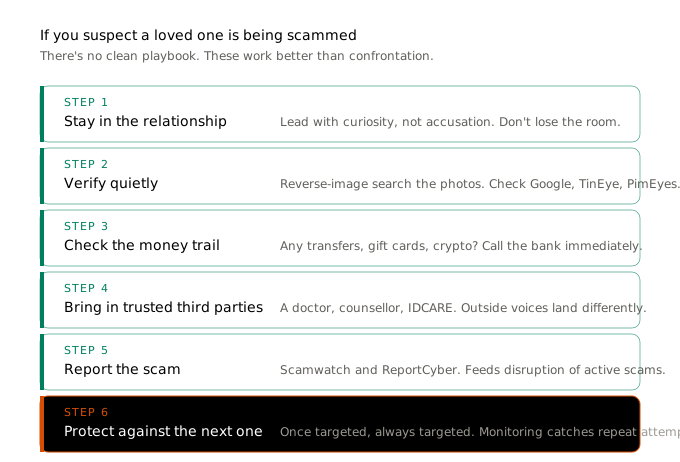
There is no clean playbook. But there are things that consistently work better than others, and things that consistently make it worse.
Lead with the relationship, not the scammer. Confronting someone with "this person is fake" almost always backfires. What tends to work better is curiosity. "Tell me about him. How did you meet? What does he sound like? Can I see a photo?" The goal in early conversations is not to win the argument — it's to stay in the room. If you lose the relationship, the scammer wins by default.
Reverse-image search the photos. Google Images, TinEye, and PimEyes can all be used to check whether a profile photo appears elsewhere on the web under a different name. A photo lifted from a real person's Instagram, or pulled from a celebrity's red-carpet appearance, will turn up. Quietly do this yourself before raising it.
Look for the financial trail. Has money been sent? Gift cards purchased? Crypto bought? If money has moved, contact the bank immediately — speed is the single biggest factor in whether any of it can be recovered. The Australian Financial Crimes Exchange coordinates between banks on scam transactions, and rapid intervention sometimes makes a difference.
Use trusted third parties. A doctor, a long-time friend, a financial counsellor — sometimes a voice from outside the family lands when family voices don't. IDCARE (the national identity and cyber support service, 1800 595 160, idcare.org) is free and specifically built for this. Their case managers talk to victims and to concerned families every day. They know how to navigate the emotional and the practical sides at once.
Report the scam. Scamwatch (scamwatch.gov.au) and ReportCyber (cyber.gov.au) are the two reporting channels in Australia. Reporting feeds the national data that allows the ACCC, police, and platforms to disrupt active scam operations. It won't always help your specific case, but it makes the next person less likely to be hit.
Protect against re-victimisation. This is where ongoing protection matters most. Once a victim's details are in scam networks, they will be approached again. Different name, different country, different story. Sometimes within days. Monitoring their digital exposure — what data is out there, where it's surfacing, what new approaches might be coming — is the difference between catching the next attempt early and watching the cycle repeat.
Where SelfCybr fits in
SelfCybr was built for exactly this part of the problem — not the moment of the scam, but the protection around it.
We help individuals and families in Australia see their digital exposure: what's been leaked in breaches, what's circulating on scam networks, where new threats are surfacing against them. We pair that with short, plain-language education built the way Duolingo builds language learning — five minutes at a time, repeated, low-friction, designed to be done by anyone regardless of technical confidence. And when something goes wrong, we point our members to the right places: IDCARE for identity recovery, eSafety for image-based abuse, banks and police for financial fraud, the specialists who do each piece best.
We don't pretend we can stop someone falling in love with a person who doesn't exist. No service can. What we can do is make sure that the people around them have visibility, that the warning signs get caught earlier, and that the second and third attempts don't land the way the first one did.
If you're worried about someone in your family right now, the first call to make is to IDCARE on 1800 595 160. It's free, it's confidential, and they will give you a plan within one conversation.
When you're ready to think about ongoing protection — for yourself, for a parent, for an adult child — we're here.
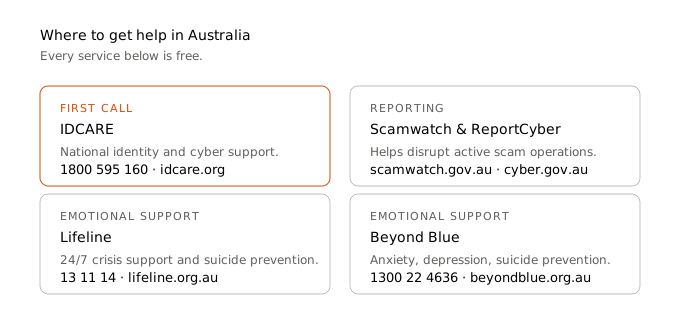
If you or someone you know has been affected by a romance scam, support is available through Lifeline (13 11 14) and Beyond Blue (1300 22 4636). Reporting scams to Scamwatch (scamwatch.gov.au) helps protect others.
SelfCybr is an Australian cyber protection service for individuals and families. Learn more at selfcybr.com.