
Census night was Tuesday 11 August. For most Australian households, that meant twenty minutes at the kitchen table, a form submitted, and a job ticked off the list.
But if you think the Census is finished with you, the people impersonating it certainly aren't.
The weeks *after* Census night are the most dangerous stretch of the whole exercise — and almost nobody talks about it. The ABS has said it will be following up with households that haven't completed a form in the coming weeks: reminder letters land in letterboxes, follow-up messages go out, and field officers start visiting doors. It is, in other words, the exact moment when an unexpected message about the Census stops feeling suspicious and starts feeling normal.
Scammers know this. That's why they wait.
Why this fortnight is the risky one
A scam works when the fake thing arrives at the moment you were half-expecting the real thing.
Right now, millions of Australians are in one of three states: they've completed the Census and are vaguely wondering whether it went through; they've half-completed it and feel a bit guilty; or they haven't done it at all and have a low-level worry about the fine.
Every one of those states is a lever, and every one of them is being pulled.
The fine is the big one. The Australian Bureau of Statistics can pursue penalties of up to **$364 per day** for refusing to complete the Census. That figure has been in the news all month, which makes it perfect scam material. A text saying *"Your Census remains incomplete. A daily penalty of $364 now applies. Pay now to avoid further charges"* is doing something clever: it isn't inventing a threat, it's borrowing a real one.
Here's what that message leaves out. The ABS doesn't fine people out of the blue. The real process is slow and full of warnings — reminder letters first, then a field officer at your door offering to help, then formal notices. Nobody gets a surprise penalty by SMS. And critically: **the ABS never asks you to pay anything, ever.** There is no Census payment. There is no Census fee. If money is being requested, it is not the Census.
The five things the ABS will never ask for
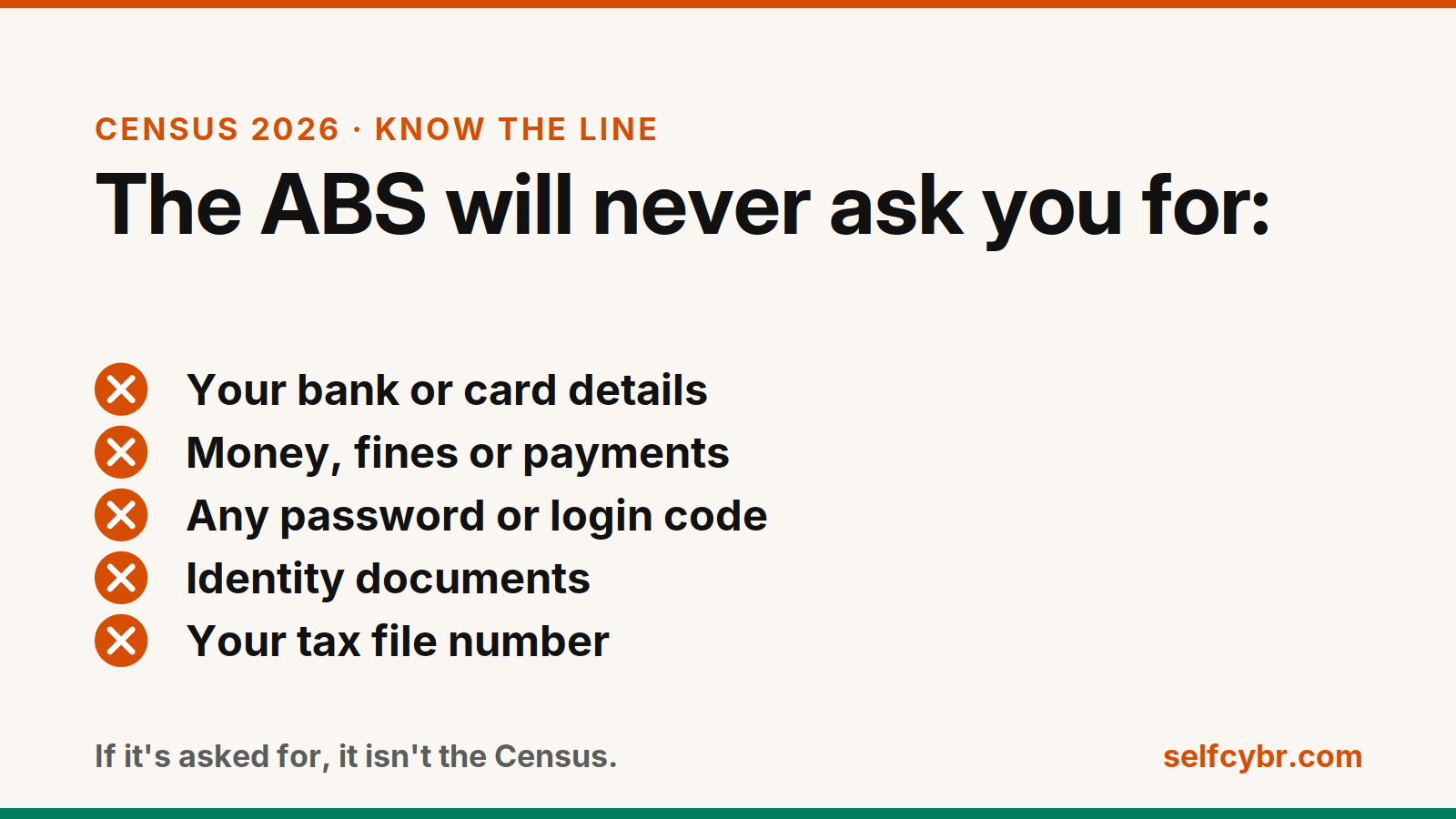
Print this on the inside of your skull. The Australian Bureau of Statistics will never ask you for:
- Your bank details or credit card information
- Money, payments, fines or donations
- Any password
- Identity documents
- Your tax file number
The ABS also won't contact you out of the blue on social media, and it won't offer you a prize, a reward or a gift card for completing your form. If any of those five things is being asked for, you can stop reading the message. It doesn't matter how official it looks. The logo is not the test. The request is the test.
How to tell the real thing from the fake
The genuine Census contacts you in a small number of very specific ways, and they're easy to check once you know what you're looking for.
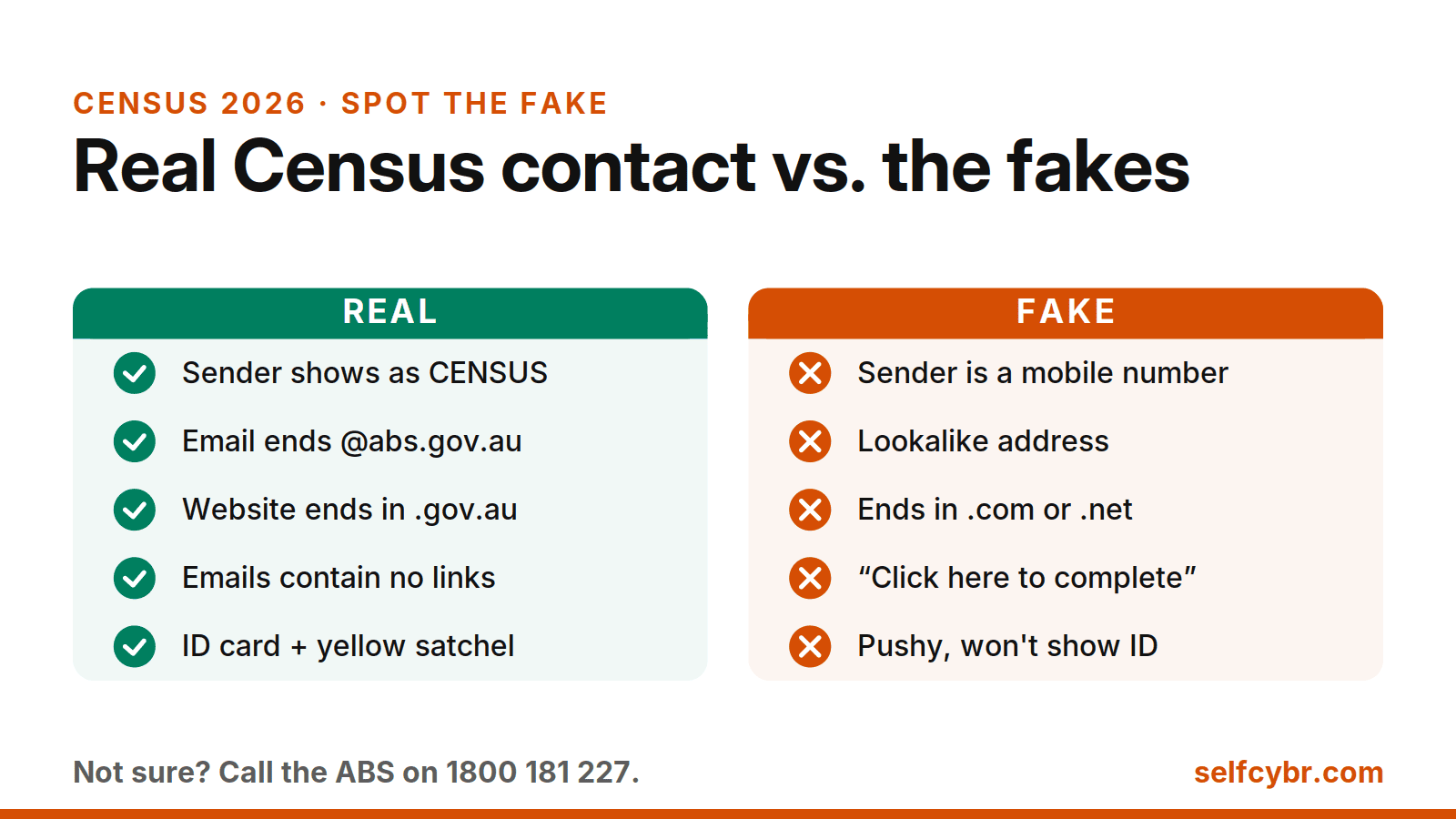
Letters. Real Census letters carry the ABS logo in the top-left corner. If there's a Reply-Paid envelope, the address on it is Reply Paid 93909, Dandenong VIC 3175.
Emails. Real ABS emails come from an address ending in @abs.gov.au — and here's the useful part: they don't contain links. If an email claiming to be the Census wants you to click through to a form, that alone is enough to bin it.
Text messages. Genuine Census SMS shows as the sender CENSUS. Not a mobile number. Not "ABS-Alerts". Not something marked "Unverified". If your phone shows a number instead of the word CENSUS, treat it as fake.
Websites. Official Census and ABS websites end in .gov.au. Never .com, never .net, never .org. A link like `census-au.com` or `abs-census.net` is a fake, no matter how good the page looks when it loads — and with AI-generated page design, they look very good now.
People at your door. ABS field officers carry an official ABS identification card and a yellow satchel. They're there to remind you or hand you a paper form. They will not ask to come inside, they will not ask for your bank details, and they will not ask for a payment. You are completely entitled to ask to see the ID card, and to close the door while you check.
The door-knock is the one to watch
Of all the contact types, the in-person visit is the one people are least prepared for.
We're trained now to be suspicious of texts and emails. We're not trained to be suspicious of a person standing in front of us being polite. Social pressure does the work that a phishing link can't: it's awkward to say no to someone's face, especially for older Australians who were raised to be courteous to officials at the door.
So, decide your answer before it happens, and tell the rest of your household what it is:
"I'm happy to help — can I see your ID card? I'll just verify with the ABS on 1800 181 227 and come back to you."
A real field officer will not be remotely offended by that. It's a normal request and they get it all day. Someone who becomes pushy, urgent or annoyed when you say it has told you everything you need to know.
And nobody from the Census needs to come into your home. Not to "help you complete it", not to "check your details", not to "verify the household". If that's being suggested, keep the door closed and call the ABS number yourself.
Stop. Check. Protect
Three steps, and they work for every scam, not just this one.
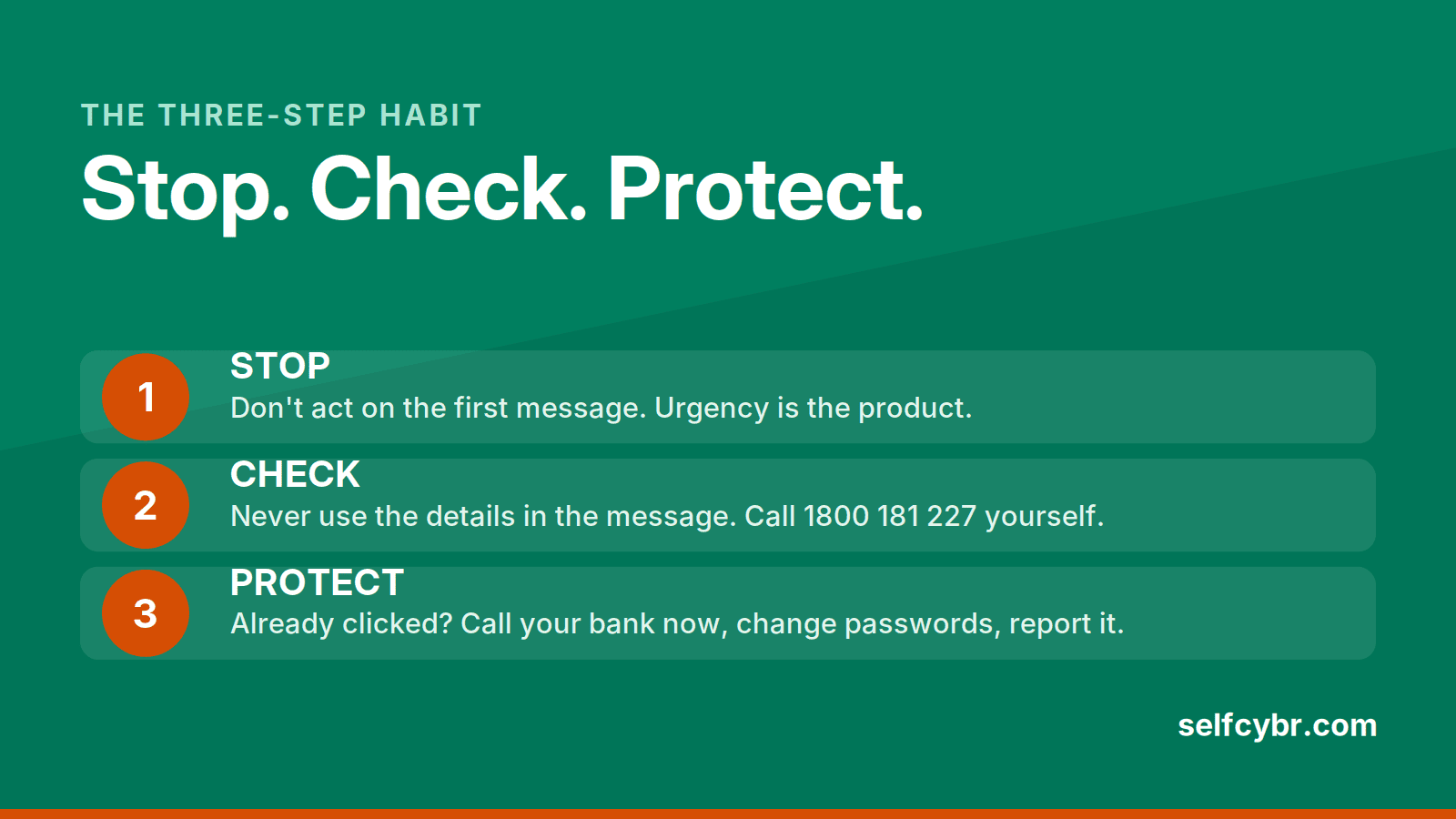
Stop. Don't act on the first message. Urgency is the whole product — the fine, the deadline, the "final notice". Genuine government processes give you time. If something is rushing you, that's the signal, not the exception.
Check. Never use the contact details in the message you're checking. Open a browser yourself, type the address in, or call the ABS Support Line on **1800 181 227**. If the message was real, nothing is lost by verifying. If it wasn't, you've just avoided the whole thing.
Protect. If you've already clicked, entered details or handed something over: contact your bank immediately, change any password you reused elsewhere, and report it to Scamwatch. Then tell someone. Speed matters far more than certainty here — banks can often stop a payment that's only minutes old.
If it's already happened
First, the thing that needs saying: this is not a failure of intelligence, and it is not something to be embarrassed about. Australians reported **$2.18 billion** in scam losses in 2025 alone, across more than 274,000 reports. These operations are professional, well-resourced and specifically engineered to work on careful people having a busy day. Shame is the reason most people wait before reporting — and waiting is the only thing that genuinely makes it worse.
If you've given up information:
- Call your bank now, on the number on the back of your card. Ask them to stop or reverse the payment and lock the card.
- Change the password on the affected account, and on any other account where you used the same one.
- Turn on two-factor authentication wherever it's offered, starting with your email — because your email is the key to everything else.
- Report it to Scamwatch at scamwatch.gov.au. This is what turns your bad day into a warning for the next person.
- Call IDCARE on 1800 595 160 if identity documents were involved. It's free, it's Australian, and they'll walk you through exactly what to do next.
One more thing, for next week
Scams Awareness Week runs 24–28 August, and this year's theme is "No one's just a number."
It's a good line. Behind every one of those 274,000 reports is a parent, a neighbour, a grandparent — someone who had a normal week interrupted by people who do this for a living.
So while the Census is still fresh, have the conversation. Ring the family member who lives alone and tell them what a real field officer looks like. Tell your kids what the sender ID should say. Agree on the household answer for the person at the door.
That five-minute conversation is worth more than any piece of software we could sell you.
SelfCybr helps Australian individuals and families see what's exposed, fix it, and learn how to stay ahead of it. No jargon, no shame, no data sold — ever. Australian-owned, Australian-hosted.